


Idle Lumber Empire: Tycoon Inc
3.913.01K Reviews
App Specs
- Version
- 1.13.0
- Updated On
- License
- Free
- Downloads
- 100,000,000+
- Developer
- AppQuantum
- Categories
- Simulation
- Platform
- Android, iOS
Screenshots







 Analysis by AppCompare
I like the appeal of a business game that can be checked in short bursts rather than demanding a long, uninterrupted session. Idle Lumber Empire: Tycoon Inc builds its play around turning a small logging operation into a larger one, with the familiar satisfaction of seeing production and upgrades move forward. It is a simulation game from AppQuantum, and its central idea is easy to understand: keep the lumber business developing, then decide where your next bit of attention will do the most good.
Small goals make the opening easy to read
The early stretch is strongest when you want clear, modest objectives. You begin with a basic operation, learn how logs become saleable lumber, and get a feel for the management loop before the game asks you to think about broader growth. That gradual start suits players who enjoy tycoon games but do not want a wall of menus or a complicated tutorial before they can make their first decisions.
I would treat the opening as a chance to notice how each step connects rather than tapping through every prompt as quickly as possible. Pay attention to what is holding production back, then use upgrades to address that bottleneck. This is a small habit, but it makes the choices feel more deliberate: an improvement is useful when it helps the whole chain, not merely because it is the newest button available.
The game is free to download and rated for Everyone, which makes it approachable for a broad audience. It has a 4.0 average from around 1.1 million ratings, and more than 100 million installs. Those figures suggest that its simple business-building premise has found a large audience, but they do not change the basic question for a new player: do you enjoy gradual progress and repeated management decisions?
Progress is easiest to judge by watching the operation
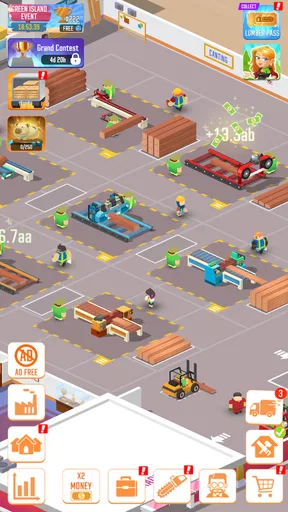
One of the pleasures here is seeing a modest logging business become more capable as you develop it. New areas and machinery give that growth a visible shape, while upgrades and managers make the business feel less dependent on constant tapping. For me, that sense of a working operation is more compelling than a large collection of abstract numbers: you can connect a decision to the activity it is meant to improve.
That also points to a useful way to play. Instead of upgrading everything as soon as you can, look for the part of the production flow that seems to be limiting progress. If one stage is lagging behind the others, strengthening a different stage may not make much difference yet. A little patience with this cause-and-effect loop can make the management feel more satisfying and help avoid spending resources on upgrades that do not solve your immediate problem.
Managers and automation change the texture of play. Early on, your attention helps get the operation moving; later, automating work lets you step away and return to a business that can keep advancing. I like that shift because it gives the game two useful rhythms: hands-on decisions when you are playing, and lighter check-ins when you are busy. It is still an idle game, though, so players who want every moment to demand a fresh tactical choice may find the quieter stretches too passive.
Worth Reading Before You Choose

EA SPORTS FC Mobile 26 Is a Bigger Football Game, but It Takes Time

Flipboard Shows What News Apps Must Do Beyond the Feed

Switching to Android Auto Means Rethinking Your Driving Routine

Google Calendar Makes a Crowded Week Easier to Manage

Ludo King Makes the Most of the Minutes Between Plans

Baby Panda World Brings Quick Play to Modern Phones, but Its Game Library Feels Busy
The challenge comes from pacing, not complicated controls
Idle Lumber Empire keeps its basic interaction accessible, but the management layer gives you choices about priorities. You can put resources toward equipment, staff, or broader expansion, and the best choice depends on what is slowing your current operation. That makes the challenge more about timing and trade-offs than dexterity. If you enjoy optimizing a small business a little at a time, this is a comfortable fit; if you want demanding controls or a story-driven campaign, it is likely the wrong kind of simulation.
Progress can also feel uneven. A run of upgrades may create a satisfying burst of momentum, followed by a period where the next step takes more patience. That is typical of idle progression, but it is worth knowing before you start: this is not a game that constantly delivers a new milestone every minute. I find it works best when I set a small goal for a session, make the most useful available improvement, and leave rather than trying to force the business to grow faster than its pacing allows.
The version currently available is 1.12.2, and the game first appeared on March 29, 2021. Its long-running presence and broad reach make it easy to find among mobile tycoon games, but the core appeal remains fairly focused: build up a logging business through incremental management. It is less suited to someone looking for a deep economic sandbox with many interacting systems, and more suited to a player who enjoys watching a clear production idea expand over time.
Free play has a sensible trade-off
There is no purchase price to get started, but optional in-app purchases range from $0.99 to $99.99 per item. I would approach those as a convenience rather than a requirement. If you are content to make progress gradually, the free-to-play structure lets you try the core loop without committing money; if waiting between milestones frustrates you, paid boosts may be tempting, so it helps to decide in advance whether speeding up is actually part of the fun for you.
For an everyday example, this is the kind of game I would open during a coffee break, make one or two focused improvements, and close once the next goal is clear. Later, I could return for another short check-in instead of needing to remember a complex plan. That pattern is particularly handy for casual players who want a low-pressure game on a phone. Someone who prefers a continuous challenge, a competitive match, or a puzzle that can be solved in one sitting would probably be happier with another genre.
The Start of Your Lumber Journey
When you first fire up Idle Lumber Empire: Tycoon Inc, you're greeted with a simple yet charming interface. The game's premise is straightforward: manage your lumber business, expand your operations, and make some serious dough. You start small, with a single sawmill and a couple of workers. But don’t worry, this is just the beginning of your journey to becoming a lumber tycoon.
The game does a great job of easing you into the mechanics. There’s a quick tutorial that guides you through the basics of cutting trees, processing logs, and selling lumber. It’s intuitive and doesn’t overwhelm you with information, which is perfect for both newbies and veteran tycoon game players.
Building Your Empire
As you progress, the game introduces more complex elements such as upgrading your equipment, hiring managers, and automating processes. The automation feature is a real game-changer. Once you start automating tasks, you can watch your empire grow without having to constantly tap away, which is what makes this game truly "idle." You can step away for a while and come back to find your business thriving.
One of the most satisfying aspects of the game is unlocking new areas. Each new zone you unlock comes with its own set of challenges and opportunities. Whether it’s a new type of tree or a unique piece of machinery, there’s always something to keep you engaged. Plus, the visual progression is quite rewarding as you see your small operation bloom into a vast lumber empire.
Managing Resources
Resource management is at the core of the game. Balancing your budget, deciding which upgrades to prioritize, and managing your workforce are crucial to maximizing your profits. The game encourages strategic thinking, which adds a layer of depth beyond just tapping your screen mindlessly.
Speaking of workforce management, the variety of workers you can hire to boost your productivity is impressive. Each worker comes with their own skills and benefits, and strategically choosing who to hire can make a big difference in your bottom line. This adds a personalized touch to how you build your empire.
Graphics and Sound
The graphics in Idle Lumber Empire: Tycoon Inc are surprisingly detailed for an idle game. The animations are smooth, and the overall aesthetic is colorful and inviting. The cheerful music and sound effects complement the gameplay nicely, making it a pleasant experience every time you log in.
The developers have done a wonderful job creating an immersive environment without going overboard. The balance between simplicity and detail is perfect, ensuring that the visuals enhance the game rather than distract from it.
In-Game Purchases
Like most free-to-play games, there are in-game purchases available. While these can speed up your progress, they’re not necessary to enjoy the game. I found that with a little patience, you can achieve quite a bit without spending real money. It’s refreshing to see a game that doesn’t aggressively push microtransactions and allows you to enjoy it at your own pace.
However, if you’re inclined to support the developers or want to accelerate your empire’s growth, there are options available. The game strikes a nice balance between being accessible to free players and offering bonuses for those willing to invest a bit.
Final Thoughts
All in all, Idle Lumber Empire: Tycoon Inc is a delightful and engaging idle game that offers hours of entertainment. Whether you're looking to kill some time or dive deep into strategy and management, this game has something for everyone. It’s easy to pick up yet offers enough depth to keep you coming back for more.
The game's charm lies in its ability to make you feel like a true tycoon, growing from a humble beginning to a sprawling empire. So go ahead, give it a try, and see if you have what it takes to become the ultimate lumber tycoon!
Who will enjoy returning to the sawmill?
The best fit is someone who likes seeing a small operation become more capable without having to play continuously. If you enjoy checking a production chain, choosing one useful improvement, and watching the result accumulate, the game offers a straightforward reason to come back. Its logging theme also gives the growth a more tangible identity than a generic cash counter: the business is about turning trees into processed goods and expanding the operation around that work.
I would be more cautious recommending it to players who need a strong narrative, frequent surprises, or a precise finish line. The satisfaction comes from incremental business growth, not from a tightly authored plot or a sequence of intense missions. Likewise, anyone who dislikes waiting in free-to-play progression may find the slow sections less charming, especially if they feel compelled to pay whenever a milestone takes longer than expected.
How it differs from other mobile management games
Compared with a hands-on city builder, this is a narrower and more relaxed kind of simulation. A city game often asks you to juggle many types of needs and layouts at once; here, the appeal is more concentrated on developing a logging and lumber operation. Compared with a tap-heavy idle clicker, managers and automation make the business less dependent on keeping your finger on the screen. That combination makes it easier to fit into spare moments, though it also means there can be less to do during a short session once you have made your main decisions.
A practical tip is to use each return visit as a quick review of the operation: identify what appears to be holding the next step back, choose an upgrade or staffing decision that addresses it, then stop when the next useful action is out of reach. This avoids scattering resources across improvements just because they are available. It also helps keep the idle format enjoyable, since the point is to make a considered adjustment rather than to turn every break into a long optimization session.
What to expect from the longer climb
New areas can provide a reason to keep going, but unlocking another zone is not automatically a sign that every earlier decision was optimal. I would treat expansion as a fresh management problem: take a moment to understand what the new stage asks of the business, then decide where to focus. The visual change is motivating, but the strongest progress signal is whether your choices make the operation feel smoother, not simply whether you have reached another label or milestone.
That distinction matters if you are deciding whether to spend. The game is free, and purchases can speed development, but paying to bypass a pause may also remove the part you enjoy: planning how to improve a small business. I would only consider an optional purchase if I already knew I liked the loop and wanted convenience, rather than treating it as a fix for a progression style that does not suit me. The available items range from $0.99 to $99.99, so it is worth keeping a personal limit in mind.
For a typical day, I can picture opening it while waiting for an appointment, checking whether the sawmill has a clear bottleneck, and making one targeted change before putting the phone away. A later visit can show whether that choice helped and whether a new area or equipment decision is now within reach. That is a better use of the game than expecting a complete management session every time; its pacing rewards recurring attention more than uninterrupted play.
My progression verdict
Idle Lumber Empire works best when I see it as a gentle, ongoing project rather than a challenge to conquer quickly. Its early goals are easy to grasp, its upgrades and automation provide visible signs of development, and the lumber theme gives the business a clear identity. Its limitations are just as clear: the pace can slow, the strategic layer stays approachable rather than becoming a deep economic simulation, and players who want constant action may prefer a more active tycoon game.
If you want a free, low-pressure simulation to check in on between other activities, I think it is worth trying. If waiting feels like wasted time to you, or you want a game where each session brings a demanding new problem, I would choose something more hands-on instead. The right expectation is simple: build patiently, make focused decisions, and enjoy the gradual transformation of a small logging business into a larger one.
Pros
- Engaging idle gameplay with gradual progression.
- Simple
- intuitive interface for easy navigation.
- Customizable lumberyard layouts for strategy.
- Offline earnings feature for constant progress.
- Regular updates with new content and features.
Cons
- Requires internet for some features.
- Advertisements can be frequent and intrusive.
- In-app purchases may feel necessary for speed.
- Occasional bugs affect performance.
- Limited social interaction options.
FAQs for Idle Lumber Empire: Tycoon Inc
What is the primary objective of Idle Lumber Empire: Tycoon Inc.?
Idle Lumber Empire: Tycoon Inc. is a simulation game where players manage and expand their lumber business. The main goal is to cut trees, process wood, and sell products to earn profits. As you progress, you can upgrade equipment, hire workers, and explore new territories to build a thriving lumber empire.
Is an internet connection required to play Idle Lumber Empire: Tycoon Inc.?
The game offers both online and offline modes. While you can play offline, an internet connection is needed for certain features like in-game purchases, leaderboards, and events. Playing online also ensures you receive the latest updates and access to special content.
Are there in-app purchases in Idle Lumber Empire: Tycoon Inc.?
Yes, Idle Lumber Empire: Tycoon Inc. includes in-app purchases that offer various enhancements such as faster progress, exclusive items, and additional resources. While these purchases can enhance gameplay, they are optional, and players can enjoy the game without spending money.
How does the game handle data privacy and security?
Idle Lumber Empire: Tycoon Inc. takes data privacy seriously. The game requires minimal personal information and follows industry standards for data protection. Users are encouraged to review the privacy policy to understand how data is collected, used, and secured within the app.
What age group is Idle Lumber Empire: Tycoon Inc. suitable for?
The game is designed for players aged 12 and above due to its strategic and economic simulation elements. It offers a family-friendly environment, but parents are advised to monitor in-app purchases and online interactions to ensure a safe gaming experience for younger players.


